Heart of Darkness
By Joseph Conrad
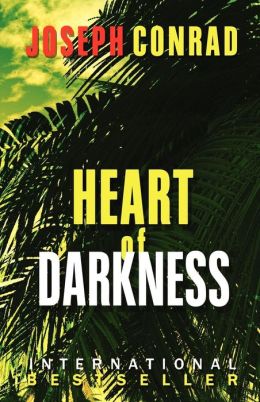
Short Story
# Pgs: 112
# Pgs: 112
_________________________________________________________________________________
Overview:
A masterpiece of twentieth-century writing, Heart of Darkness (1902) exposes the tenuous fabric that holds "civilization" together and the brutal horror at the center of European colonialism. Conrad's crowning achievement recounts Marlow's physical and psychological journey deep into the heart of the Belgian Congo in search of the mysterious trader Kurtz.
Joyce Carol Oates on Joseph Conrad's Heart of Darkness:
Heart of Darkness has had an influence that goes beyond the specifically literary. This parable of a man's 'heart of darkness' dramatized in the alleged 'Dark Continent' of Africa transcended its late Victorian era to acquire the stature of one of the great, if troubling, visionary works of western civilization."
_________________________________________________________________________________
Review... Er... Essay?
Yeah, so instead of a book review I'm going to post my Heart of Darkness essay here. It's going to be boring, but I needed the grade... Sorry. I can tell you that Heart of Darkness holds a lot of beautifully interesting, however drawn out, contrasting light and dark imagery. It adds to the sense of horror about the short story. That's one thing that I actually love about this book. However, as a YA, it took a lot of patience to read just because there is so much imagery and description involved within it's pages. The symbolism is amazing. It was a drag to read so early in the morning (as a requirement for my English class) but I think that under different circumstances, there might've been the slightest chance the I might've liked it more than I did. Just the littlest bit, though, and I wouldn't have ever read this book on my own. It's not the kind of book that I'm usually reading. Then again...
In any case, prepare for boring. Here's my essay (and if you copy it for your own English essays then know that that is cheating and I will hunt you down and massacre you with a broomstick, whoever and whereever you are. Cheating is not fair. It's cheating. There's really nothing more I need to say. Just get off your lazy butt and write it yourself. God. Ok, now I'm done, and here's the boring essay! ^^):
Joseph Conrad, who was a dominant British author throughout the late nineteenth and early twentieth centuries, wrote Heart of Darkness in 1899 to convey that it is within human nature to search for a source of light within the dark. This means that people will always try to find the good in what can seem like a malicious, or bad, time. This does not mean, however, that they will find that light. In Joseph Conrad’s Heart of Darkness, Conrad uses vast amounts of contrasting light and dark imagery to support this theme throughout the novella.
Throughout the novella Heart of Darkness, Joseph Conrad continuously writes in such a way that light gives in to darkness. It was with this in mind that the main narrative character, Marlow, first yearns to set out to Africa. As such, Marlow states, “Light came out of the river since---you say Knights? Yes; but it is like a running blaze on a plain, like a flash of lightning in the clouds. We live in the flicker---may it last as long as the old earth keeps rolling! But darkness was here yesterday.” To this Marlow refers to the British imperialism that is happening in Africa during this time period. What was once unknown or dark to them, the heart of Africa, became light with knowledge. Meaning that something within Africa became known to the British imperialists to be of value, which is at the time considered good. This “light” in the dark of Africa is ivory; the tusks from elephants. However, in comparing the happiness of the discovery to a flash of lightning, Marlow is foreshadowing that the good about this situation will not last. Marlow likewise compares the darkness of Africa, all that was unknown about it, to a snake. He says that, “The snake had charmed me.” The snake is a familiar element of symbolism in literature. Consider the “Book of Genesis” from the Bible in which a snake also tricks Eve into eating an apple from the tree of Life. If the snake in Heart of Darkness refers to the darkness, or all that is not yet known of Africa, then Marlow’s statement about the snake charming him means that Marlow gave in to his temptation to, in a sense, eat an apple from the tree of Life. Marlow wants to shed light on the British imperialistic situation in Africa, and thus what Marlow at first considers a good thing (imperialism) is “...like a flash of lightning in the clouds.” The good will soon give way, but Marlow still looks for it. To do so, Marlow uses his aunt’s connections in “the Company” to become the captain of a steamboat in their employ. Once made a captain, he goes to the the heart of darkness; the heart of Africa.
Throughout the rest of Joseph Conrad’s Heart of Darkness, Marlow encounters men with “hearts of darkness”. Towards the beginning of part two, Conrad uses imagery in Marlow’s narrative to symbolise how Marlow himself is finding his own heart of darkness. Marlow describes, “The sun was low; and leaning forward side by side, they seemed to be tugging painfully uphill their two ridiculus shadows of unequal length, that trailed behind them slowly over the tall grass without bending a single blade.” Marlow is speaking about two men who just a moment before he had eavesdropped upon. Marlow overheard them speaking about hanging another man named Kurtz, who up to this point had only briefly been spoken about in an almost idealised tone. Conrad’s imagery here seems to make the tone more menacing, if it weren’t already made so by Conrad’s earlier imagery. The sun becomes like Marlow’s hope for Africa. That light he once saw in the mystery of Africa is setting. In the sun’s setting there is revealed the darkness that Marlow is beginning to see about all men in the shapes of the two irregular shadows of the retreating men on the hill. Conrad describes their ascent with an image as if the two men have to “painfully” carry their darkness with them uphill, heading towards the sun which is now setting. In this, Marlow begins to see their darkness. In the next paragraph, Marlow begins to reveal said darkness unknowingly within himself. He does so with the words, “Long afterwards the news came that all the donkeys were dead. I know nothing as to the fate of the less valuable animals. They, no doubt, like the rest of us, found what they deserved. I did not inquire. I was then rather excited at the prospect of meeting Kurtz very soon.” The sun is setting on the light within Marlow, as seen with Marlow stating that the men in this expedition were “animals” of less value than the dead donkeys. As Marlow is still talking about the two men who were earlier walking towards the sun set with their “ridiculous shadows”, Marlow reveals his own inner darkness. As to the statement of saying he was distracted by the “prospect of meeting Kurtz”, Marlow reveals the new light in which he travels towards. Like the two men before him, Marlow is traveling towards a sun, which reveals his own ridiculous shadow. Likewise, as Marlow himself gives in to a heart of darkness, so too does his idealism for the British imperialism in Africa. The lights in both the hearts of Marlow and Africa are revealed to be dark. Kurtz is Marlow’s only hope that there is still some kind of good about it all.
It is within part three that the aforementioned lightning storm finally passed, the “flicker that we live in” went out. This is as a result of Marlow finally meeting Kurtz, his last hope for light, and seeing that there was none. Marlow, referring to Kurtz, states that “His was an impenetrable darkness. I looked at him as you peer down at a man who is lying at the bottom of a precipice where the sun never shines.” Singularly, this statement refers to Kurtz, who had become the symbol for Marlow’s hope about the imperialism within Africa, and to Marlow. Kurtz, Marlow learns by the end, holds one of the darkest hearts of all. Marlow, with no hope left of Africa, with the discovery of just what Kurtz did to get the ivory, and with all the dark hearts he had seen from others thus far, completely gained his own heart of darkness. “The vision seemed to enter the house with me---the stretcher, the phantom-bearers, the wild crowd of obedient worshippers, the gloom of the forests, the glitter of the reach between the murky bends, the beat of the drum, regular and muffled like the beating of a heart---the heart of a conquering darkness.”
Joseph Conrad successfully used light and dark imagery to show how it is only human nature for a person to look for the rightness within a potentially wrong situation. Conrad stresses, however, that a person may not find the “light” in it, although that is always what a person is moving towards. Conrad used Marlow as an example for this idea. Every time that Marlow found a light to head towards, he found darkness there instead. Marlow would then choose a new light to focus on, and instead once again be lost in the dark. As such, it is only within human nature to search for the light in dark situations, despite not always finding it.

No comments:
Post a Comment