Thursday, May 8, 2014

"Dorothy Must Die" by Danielle Paige (DD2)

The Yellow Brick Road Crumbles...

Dorothy Must Die

Danielle Paige

The Dorothy Must Die Series, Book 1
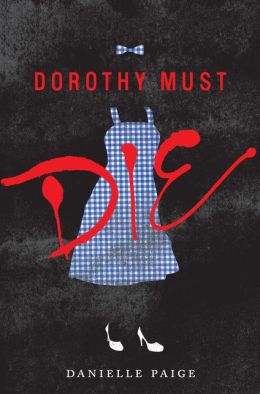
Dorothy Must Die

# Pgs: 464

_________________________________________________________________________________

Overview:


I didn't ask for any of this.

I didn't ask to be some kind of hero.

But when your whole life gets swept up by a tornado—taking you with it—you have no choice but to go along, you know?

Sure, I've read the books. I've seen the movies. I know the song about the rainbow and the happy little bluebirds. But I never expected Oz to look like this. To be a place where Good Witches can't be trusted, Wicked Witches may just be the good guys, and winged monkeys can be executed for acts of rebellion.

There's still a yellow brick road—but even that's crumbling.

What happened? Dorothy.

They say she found a way to come back to Oz. They say she seized power and the power went to her head.

And now no one is safe.

My name is Amy Gumm—and I'm the other girl from Kansas.

I've been recruited by the Revolutionary Order of the Wicked.

I've been trained to fight.

And I have a mission.

_________________________________________________________________________________

Review:

Absolutely loved this book. I mean, it's not the best out of the best, but it's still become one of my favorites. The Wizard of Oz theme has been very "in", in the past couple of years; exploring with the world and the plot of the original story. This book isn't different.

The way I can best explain it, the main character-- Amy-- is living this terrible, purposeless life in Kansas. After having a brief confrontation with her dead-beat mother, she gets swept up in a tornado and ends up in Oz with her mother's pet rat, Star (I'm still a little concerned: who has a pet rat named Star?). Oz isn't at all what it's cracked up to be in the movies that Amy's seen. Concerned, she embarks on an adventure to the Emerald City in order to go home. Along the way, she gets swept up in the whirlwind drama and danger that Oz has become. Why? Answer: Dorothy.

Dorothy, in this story (though I know it's hard to imagine it if you've ever seen the movie) is the antagonist in this story; she's the main problem from which all the other complications stem. The main question that carries us through this story is "How is Dorothy taken down?" and "Will Amy ever go home to Kansas?"

At times, it was somewhat difficult to read this book in that my interest was lost. While the storyline itself was interesting and somewhat complex, the story seemed to drag on; the pace of the book was a little slow. Things happened perfectly at the beginning with Amy and her trailer getting thrown over to Oz in the tornado, but then the pace slows down a bit. I suspect part of the reason might be to give the reader examples of how terrible Oz has become. Glinda the "Good" witch isn't so good; the Cowardly Lion isn't so cuddly; the Scarecrow got his brains, and now performs mad-science, Frankenstein experiments in the name of Oz; the Tin Woodsman is the obsessed-with-Dorothy head of Oz's tin police force; Dorothy is the ruler conducting it all. Meanwhile, the "Wicked" might not be so wicked, and Amy's just the pawn being played across the board.

We see examples of these things throughout the story. When things slow down are when these "terrors" of Oz are emphasized and portrayed in this somewhat grotesque, macarbre way. When the pace of the book picks up usually begins an attempt to resolve one of the previous problems that happened in the "slow" and/or another conflict is introduced. When things slowed down, however, my interest was somewhat lost, though I usually picked the book back up a couple of hours or so later.

I'm kind of creeped out by this book, to be honest. There's a sense of horror here that really plays with the reader's mind, especially if they can recall the innocense that the movie or music or such portrayed. The innocense in this book was distorted and misconstrued. It gave me the feeling, as I read this, of madness and horror. Sometimes, though my interest was lost, I was nonetheless reluctant to put the book down. My curiosity remained, as did that thought of "What happened to Oz?"

I'm not quite so sure I relate to Amy completely. At the beginning of the book, her character is one that is all bark and no bite. She can dish out the snark to a degree, but she doesn't really stand up for herself beyond that, and she doesn't back up that snark at all with anything solid. Throughout the rest of the book though, we see her character grow and that inner fight in her come out. The innocense of Oz is lost, and whatever innocense might remain comes from Amy. This is kind of funny in the sense that even Amy's innocense is off. It's just, where there is death and grotesque figures about Oz, Amy's not touched that death yet, and for when she does or attempts to, even then it's done in a sort of righteousness or justice. Amy's the hero, the pawn; she's the other girl from Kansas.

There isn't really much romance in this book, though there is definitely a sort of supporting character with which Amy shares an interest. Mostly, this book is adventure and a fictional spin-off of the classic The Wizard of Oz. I flipped-flopped back and forth from two and three for the majority of the book before settling on a four out of five at the end of the book. In the end, I thoroughly enjoyed this book and highly anticipate the next book in the series. In fact, I'm nearly going insane with waiting. Like I said at the beginning of this review, it might not've been the best book ever, but it still was very interesting to read and I enjoyed it to a high degree.

Lots of death and destruction. The Lion kind of creeps me out. The Scarecrow really creeps me out. The Tin Woodsman is just evil and desperate. Dorothy is just spoiled in a childish way; when she doesn't get what she wants, she gets revenge.

All in all, fun to read. Be prepared to read. I finished this book in two days.

With all that said, thanks for reading. :)

Tuesday, May 6, 2014

"Talker 25" by Joshua McCune (DD1)

Chaos With a Pattern

Talker 25

By Joshua McCune

The Talker 25 Trilogy, Book 1

Talker 25

# Pgs: 432

_________________________________________________________________________________

Overview:


"Wakey, wakey, everyone."
It's Monday. I think.
Technically, I've been here a week.
Feels like forever.

Melissa Callahan has always hated the dragons. They destroyed her mother, her family, her home. And now she's been charged with collaborating with them, with being an insurgent, and she's been thrown into a cell to . . . well, to what? Think about her nonexistent crimes? Think about how great her life once was? Think about James and her father and her brother and the lies? Think about escaping, when everyone knows that's impossible since the ice stretches forever and the cold is unbearable and the dragons can't hear her anymore.

Melissa Callahan is OTG. Off the grid. And so is Talker 1 and Talker 2 and Talker 3, 5, 7, 11, 22, 26 . . . all of them talking, constantly talking, into the void. All of them waiting for an answer.

_________________________________________________________________________________


Review:
When I first began reading this book, I was a little confused. And as I continued to read the book, I became more and more confused. New names and places were kept thrown at me before I had time to discern just who was who and what was what. The beginning of the book especially seemed to be set at a fast pace- In the span of just a day in the book's timeline, huge plot developments continued to happen, one after another. By the time I reached the end of the book, nothing had been as exciting, or confusing, as the beginning. It was felt like the climax was at the beginning of the book rather than more towards the end.

As I read on, the book began to level out. Things began to make more sense, and yet still now, after I've finished reading it, I'm still confused on who's who. I don't know who some of the characters or names are, or what relevance they have to the story. The only few that seemed to make sense were the two main characters, Baby, and a few of the characters introduced in the last chunk of the book.

The beginning of the book was just set at such a fast pace that it was difficult to recover from having all these plot twists thrown at me at once. Just as I was beginning to understand or sympathize with the character, another plot twist would be introduced and I'd become just as lost as I'd been before.

However conflicted I am by the beginning of the book, by the end I'd adjusted quite nicely (however, still confused) and I'd enjoyed the book, I can't say that I related much to the character, but I could sympathize with her greatly. Maybe it was just the maternal instincts in me. Once I understood what was happening, though, I was drawn into the storyline and what was happening. My curiosity was irreversibly fed, and it starved for more, and I couldn't stop reading it because however confused I was it was interesting. It was enjoyable to read, and I needed to see that conflict resolved.

With this in mind, a new question had been introduced to me at the end and I'm infinitely going crazy to keep from going completely crazy over the fact that the next book in the series isn't out yet. I don't think. Anyway. :P

So I'd probably give this a three out of five, because I can't say that it was a terrible book- it was just all over the place and slightly confusing; a type of chaos that has a pattern you can't quite read until you get midway through it. O.o You know, that's actually a perfect way to describe it. I can't say it was a terrible book despite its many problems because overall, the concept was a great one, and I was effectively drawn into the story and able to sympathize, if not connect with, the characters.

So, a three out of five, and I'd recommend this to modern fantasy, slightly dystopian society, also maybe slightly sci-fi, lovers. There's a touch of romance in this, just a spark as to the fact that the main character Melissa has an antagonistic/protagonist supporting acquaintanceship with the main character James and she's clearly attracted to him. No kissing, though, and there's not anything lovey-dovy about this. Just a little spark of interest and betrayal.

With that in mind; thanks for reading.

Wednesday, April 30, 2014

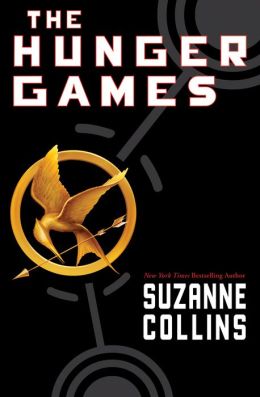
"The Hunger Games" by Suzanne Collins (CC1 & CC2)

Rebel Against the Status Quo

The Hunger Games

By Suzanne Collins

The Hunger Games Series, Book 1


The Hunger Games (Hunger Games Series #1)

# Pgs: 384

_________________________________________________________________________________

Overview:


In the ruins of a place once known as North America lies the nation of Panem, a shining Capitol surrounded by twelve outlying districts. The Capitol is harsh and cruel and keeps the districts in line by forcing them all to send one boy and one girl between the ages of twelve and eighteen to participate in the annual Hunger Games, a fight to the death on live TV. Sixteen-year-old Katniss Everdeen, who lives alone with her mother and younger sister, regards it as a death sentence when she is forced to represent her district in the Games. But Katniss has been close to dead before-and survival.
_________________________________________________________________________________

Review:


When I first read The Hunger Games by Suzanne Collins about six years ago, it was just a secret treasure. It was one of those things where I read the book, loved it beyond belief, and tried to convince anyone and everyone who would listen of its greatness. Of course, no one would listen to me, and so the secret was kept. People have a habit of ignoring great things until said things are exposed to the status quo. For years The Hunger Games remained one of my secrets, and I came possessive of it. By originally defending it from others who chose to mock it, as well as how fond I was of the plot and symbolism, this book (in a sense) became mine. That’s something that happens with the books I love the most.
And then the tragic part happened when I came into school years later and everyone was raving about the book, and explaining to me how awesome it was, and how it’s going to become a movie. Anger was one of the main emotions during that one period, and a sort of jealousy perhaps. That book was mine. I defended it. I knew the words, the story, and the characters. I knew them first. They wanted to explain to me its wonder? They wanted me to read the book I already read?
Once the popularity slightly blew over, though it waited eagerly in the shadows in patience, again people felt the need to mock it. Like, it’s a great book, and I’ll talk about it for the first month, but once everyone else likes the book and is talking about it then I’m done with it. Other people liking something that I like are so yesterday, so I’m going to insult it. The novelty is lost. That’s how popularity works, I suppose, and it’s exasperating.
Now that I’m done with all of that frustration, let’s actually talk about the book itself. To begin with, I want to point out the awesomeness of Peeta Mellark being the son of a baker and having the name Peeta (pronounced pita, like pita bread). With that done, I also want to point out that people are wont to focus on the melodramatic, angsty, teenage romance over the actual theme of the book, so give this book some credit. I mean, love is a big thing in this book, but so is war. So is a dissatisfaction and fear of the government. The government runs on fear, it controls its people with fear and a lack of knowledge. I mean, there are twelve separate Districts, each with different specialties like coal mining and fishing and industry. No one district knows something to the extent of the next, which likewise keeps the people under the government’s power. And the hunger games themselves are there to make people believe that they are helpless, that the government can do anything they want to do to you and there is nothing you can do unless you want to face the consequences.
The movie portrays the whole thing like Peeta and Katniss were destined to be together, almost, but that’s not the case at all. Peeta is actually a disappointment in the sense that had they not both been called for the hunger games, he probably wouldn’t have spoken up at all about his love for Katniss, and Katniss would’ve eventually married Gale. Katniss actually loved Gale, though the difference between her love for Gale and her love for Peeta stems from the fact that she only fought for her life alongside one.
For Katniss- she didn’t love Peeta at all in the beginning. I’m not even sure she fell for him in the first book, though by the end there must’ve been some kind of an interest. That’s not to say that she didn’t care about him at all, but for her that whole romance between them was a matter of convenience. She had no idea that Peeta actually loved her. I mean, he announced it for the first time on live television, during the period where each of the tributes had to suck up to the rest of the world. What was she supposed to think other than that it was a ruse? For all she knew, at the beginning, he was the enemy. I mean, sure, they were some sort of allies, but it hadn’t really extended beyond that until the tracker-jacker incident when Peeta risked himself to help her get away, and when they fought  together to stay alive. After that, they became “brothers of war”. There’s something to be said about fighting for your life alongside someone else just as determined to stay alive, to keep each other aside, for as long as possible. The option of loving Peeta hadn’t even been made aware to Katniss, though to us it was clear, until the end. That might’ve been the actual spark which allowed her to feel.
Okay, so maybe I’m a little caught up on the romance aspect too—but all Katniss was trying to do was to stay alive so that she could make it home to her sister. She was doing it for her sister, for herself, and for Gale. She made a promise. She kept Peeta alive because they were in it together, they came from the same district, she didn’t want her sister or her district to be disappointed in her, and she didn’t want to lose herself—her integrity—to the games. By playing along with the whole “in love” thing, in benefitted her and increased her chances of survival. More than that, having love and something to hope for in a place that supposed to be hopeless was an act of defiance.
Katniss was all about defiance. It’s why she became the symbol, and the mocking-jay became the symbol, for freedom and rebellion later in the series. The berry scene? It wasn’t to bring Peeta home with her. It wasn’t because she loved him. It wasn’t for her sister, or for Gale, or for her district, or anything. It was an act of rebellion. The Capital had to have a winner for the Games, but someone had to die. Katniss convincing Peeta to trust her and eat the berry was symbolic for saying that the people of the districts, those in poverty and repressed by their government, they still had power. Katniss, the people, they could control the government. All or nothing.
I still love this book a lot, and I probably could keep going on about it. I mean, it’s not my top book ever, but it’s still one of my minority favorites (if that makes any sense). I didn’t like the second book so much; I thought that it was repetitious of the first book, and after reading the third I thought that the basic plot lines of the last two books of the trilogy would’ve been so much more effective had the plots of the second and third books been switched. After reading the third book, I threw it at the wall. I liked it less than the second. I might’ve actually appreciated it had the basic plot line come after the first book, and the basic plot line of the second come after that. I don’t know if that explanation makes any sense, but that’s what I think. The plots of the second and third should’ve been switched. There, that says it all.
All said and done, I definitely would rate this as a five out of five and recommend it for lovers of the dystopian society, sci-fi, somewhat romantic, power to the people, people. That said, thanks for reading.

Monday, April 28, 2014

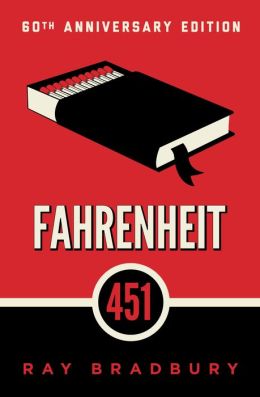
"Fahrenheit 451" Ray Bradbury (BB2)

Testament to its Greatness

Fahreheit 451

Ray Bradbury

Fahrenheit 451

# Pgs: 256

_________________________________________________________________________________

Overview:

Ray Bradbury’s internationally acclaimed novel Fahrenheit 451 is a masterwork of twentieth-century literature set in a bleak, dystopian future.

Guy Montag is a fireman. In his world, where television rules and literature is on the brink of extinction, firemen start fires rather than put them out. His job is to destroy the most illegal of commodities, the printed book, along with the houses in which they are hidden.

Montag never questions the destruction and ruin his actions produce, returning each day to his bland life and wife, Mildred, who spends all day with her television "family." But then he meets an eccentric young neighbor, Clarisse, who introduces him to a past where people didn’t live in fear, and to a present where one sees the world through the ideas in books instead of the mindless chatter of television.

When Mildred attempts suicide, and Clarisse suddenly disappears, Montag begins to question everything he has ever known. He starts hiding books in his home, and when his pilfering is discovered, the fireman has to run for his life.

First published in 1953, Fahrenheit 451 is a classic novel set in the future when books forbidden by a totalitarian regime are burned. The hero, a book burner, suddenly discovers that books are flesh and blood ideas that cry out silently when put to the torch.

_________________________________________________________________________________

Review:

Okay, I just want to say that before we begin, I read this book about two and a half years ago. With that said, I still remember the majority of what happens in this book. Maybe the character names are a little blurry, but everything else is still up there in whatever memory space lazes about in my mind. We should give this book credit just for that: me being able to remember it. I've read some books in the past year, and I've written about them here on my blog, but I can't even begin to remember what they're about. I remember nearly everything about this book.

That done, let's actually talk about the book itself. If from reading the general overview above you still don't have any idea what it's about, then let me try to simplify it. The main character, Guy Montag, is a fireman- he burns books. His society is dystopian, and controlling. It's illegal to own or read books outside of what's allowed (That's one of our freedoms in America, freedom of the press- read and write without, supposedly anyway, any interference from the government; regardless we take it for granted). After having a couple of those "fateful" life situations thrown at him, Montag started to question the things he originally believed. With that, he does something illegal: keeping and reading the books in his home. The rest from there is history.

This book is a lot more interesting than it might sound.

I mean, we in America already take what we have for granted. When reading Ray Bradbury's Fahrenheit 451, all of that reality is just kind of shoved back in your face. In this book, they can't read. And they have about a billion TV's. And the technology is so advanced that it's like, what else are these characters supposed to do but let everything else think for them?

This book is just shocking to read. It's insightful. The symbolism, foreshadowing, and the message that each of these conveys is still very much applicable to today's society. There really isn't any way to go into it without saying that the way Bradbury writes about society is just amazing. It truly is. I mean, the plot isn't action packed and full of wham-bam, mind blown in the car crash that happened somewhere in chapter thirty-three. There's no lusty romance where the main character, Bella Swan (an angsty and overall emotionless character in the movie), will absolutely kill herself over not having the one sparkly vampire as a lover.

Fahrenheit 451 is just heartbreaking once you understand and adjust. Bradbury wrote this book somewhere in the 1980's, and most books nowadays don't write like this. We've adjusted to modern views and the easy stamp out plot that teen fiction books are wont to have. So sometimes reading something like this is confusing, or hard to get into, just because we're so used to reading something easier. We shouldn't kid ourselves, and I'm not going to lie, that's one of the reasons that I read teen fics today (aside from the fact that I am a teen- or is it young adult now?). They're easier than the classics, but that doesn't mean I can't enjoy the classics as much as if not more than today's fics. In Bradbury's case here, it's the message that leaves behind such an impact, and it's the way he portrays these ideas and beliefs. He was completely against development in technology. This is just one such example of these views.

And, in the end, isn't he right?

I think you should read the book and find out that answer for yourself. Find out just what Bradbury is saying, and let me know what you think about technology, or our rights, what we take for granted, what we don't even know we have, whether you agree with the massive event that happens just before the end of the book, whatever. Just let me know what you think. Or just think.

Really, I think this book deserves it.

That said, I'd recommend it to high schoolers and up- so fourteen to eighteen year olds and up. I think that they'd have a likelier chance to understand just what Bradbury's saying. Definitely for lovers of dystopia, sci-fi, symbolism in both the book and with life, and etc. Thanks for reading!

Thursday, April 24, 2014

Creative Writing Subject: Spring (BB1)

My Own Creative Writing

Soldier's March

(I just started writing it and it worked for me. Purely fictional. I may add more later.)

___________________________________________________________________________________


                It started with a drum. Soldiers were passing by, their feet marching in a steady rhythm, hands beating on their shields and drums. Their faces were blank and unyielding, though their eyes were proud. Straight backed, cleanly shaved, their uniforms were sharp and crisp, and they stood tall as they walked. I hid behind a shopkeeper, clutching at her dress as I peered out amazed as they walked by.
                I had never seen the King’s soldiers before.
                They passed by quickly. Their drumming of feet and hands still echoing on in their wake, and ran began to fall. Everything else had been silent, in honor of the King’s soldiers. Everyone, even the littlest of children, knew that when the King sent his soldiers to march on Raugsbard, they did not return.
                So the rain fell, and the soldiers marched, and we were silent.
                After the noise of their thrumming feet diminished, the whispering began. Like the rain, it began in small torrents. It came quietly at first, the rumors and the gossip about the war and the King’s soldiers, but then cascaded louder and colder and harder from their mouths, encouraged by their fear.
                I was a child, one that did not yet understand the words that spread from their lips just yet, nor of the politics of the kingdom. All I had been concerned with was finding a dry place to sleep that night, and, if I was lucky, some food to fill my stomach.
                Most of the people that crowded this street knew me, a little street urchin. No good, and unwanted, I fought with the stray dogs for scraps. Those people would watch and laugh. But at least I was fed.
                The cold rain pelleted my head and I shivered, realizing then that I still clutched this stranger’s clothes. Instantly I unclenched my tiny fists and wrapped them around myself instead, shivering from the rain. The woman turned to look at me.
                The crowd, who had ignored the small trickling of water at first, now seemed to vanish to get out of the rain as it began to fall heavier. Like them I searched for a dry shelter to hide away at, at least until the rain stopped. I spotted a small hanger over the doorway of a home, a little nook with just enough room for me to stand in and wait. I walked towards it. The woman watched me go.
                The rain fell, and the soldier’s marched.
              

Tuesday, April 22, 2014

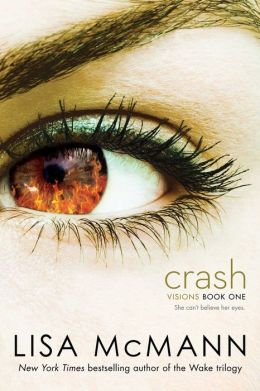
"Crash" by Lisa McMann (AA1 & AA2)

Boom

Crash

By Lisa McMann


Crash

# Pgs: 256

_________________________________________________________________________________

Overview:

If what you see is what you get, Jules is in serious trouble. The suspenseful first of four books from the New York Times bestselling author of the Wake trilogy.

Jules lives with her family above their restaurant, which means she smells like pizza most of the time and drives their double-meatball-shaped food truck to school. It’s not a recipe for popularity, but she can handle that.

What she can’t handle is the recurring vision that haunts her. Over and over, Jules sees a careening truck hit a building and explode...and nine body bags in the snow.

The vision is everywhere—on billboards, television screens, windows—and she’s the only one who sees it. And the more she sees it, the more she sees. The vision is giving her clues, and soon Jules knows what she has to do. Because now she can see the face in one of the body bags, and it’s someone she knows. Someone she has been in love with for as long as she can remember.

In this riveting start to a gripping series from New York Times bestselling author Lisa McMann, Jules has to act—and act fast—to keep her vision from becoming reality.

_________________________________________________________________________________

Review:

This book wasn't impressive. I mean, there was nothing really about the plot that stood out to me. Everything just seemed so... predictable. The situation in the book is alike to Romeo and Juliet- two characters that are forbidden from being together due to some "unknown" family feud. It's like a case of he said, she said the entire time. The source of the family problem isn't revealed until the end, and by that point I was just so exhausted from reading the first part of the book that I wasn't surprised or shocked or anything. It was just information that "went in one ear and went out the other". I mean, there really wasn't anything about the book that stood out to me.

There was light humor, don't get me wrong. And the main character was relatable. But... I mean, there really wasn't anything else that I liked about this book. Maybe it was just the different times that I took to read the book (I put it down quite often) but it was boring. The only thing that kept me reading it was my desire to see if I was right about how it would play out. And I was.

Not even a third of the way through the book I predicted how it would turn out. To me, it just seemed like the main character, Jules, was overcomplicating everything. She tried her best to figure out the clues she was given so that she could stop the crash, but at times it just seemed like the author was purposely making her oblivious. Don't get me wrong, this wasn't a bad book; it was just unimpressive and slightly disappointing. The only originality that came from this book appeared at the end, when the situation resolved itself and then a new, strangely similar situation reappeared- which preps the reader for the next book in the series- and also from the Jules' father's depression which was ultimately a result of the reason behind the family feud- but even the feud itself wasn't at all that difficult to figure out. Maybe this book just wasn't for me, but I wasn't hooked at all.

The reasoning behind the visions Jules is having is not explained at all, so maybe that's also supposed to hook us into the next book in the series.

I don't know. Going into this book, I guess I expected more. I'm disappointed. Everything about this book felt like it should be for a younger generation than it is. It was just so childish to the point where it wasn't cute or funny or endearing. It was just exhausting. Not for high school-ers. Maybe middle school-ers. Maybe it's just "to each their own".

It wasn't a horrible, disgusting excuse for a novel. In that, I suppose it doesn't deserve a rating any lower than a one and a half. It was just so disappointing, and really not all that enjoyable to read. It didn't capture my attention. I didn't get hooked. I only wanted to see if my predictions were correct or if the book would surprise me at all, but it didn't. I was right.

Recommended for those around twelve years of age, who like Romeo and Juliet type of forbidden love books, with just a tough of what seems like it might be supernatural. Kind of random in that aspect, really. The visions, that is. Whatever. I've given up. I don't like this book, but I didn't hate it with every fiber of my being. Maybe you'll like it. Who knows? Just... be careful.

With that in mind, thanks for reading- leave a comment if you feel like disputing the situation that presented itself. Leave a comment if you have no idea what that means. Or not. You know, whatever works.

Friday, April 4, 2014

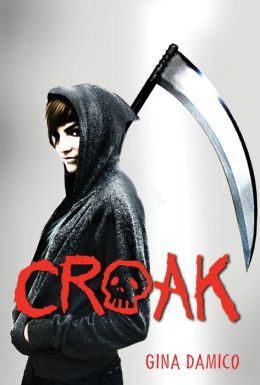
"Croak" by Gina Damico (Z2)

Unorthodox and The Five Stages of Grief

Croak

By Gina Damico

The Croak Series, Book 1


Croak

# Pgs: 320

_________________________________________________________________________________

Overview:


Fed up with her wild behavior, sixteen-year-old Lex’s parents ship her off to upstate New York to live with her Uncle Mort for the summer, hoping that a few months of dirty farm work will whip her back into shape. But Uncle Mort’s true occupation is much dirtier than shoveling manure. He’s a Grim Reaper. And he’s going to teach Lex the family business.

   She quickly assimilates into the peculiar world of Croak, a town populated by reapers who deliver souls from this life to the next. But Lex can’t stop her desire for justice—or is it vengeance?—whenever she encounters a murder victim, craving to stop the attackers before they can strike again. Will she ditch Croak and go rogue with her reaper skills?

_________________________________________________________________________________

Review:

Upon finishing this book, I threw it at the wall.

You know, like literally threw it at the wall.

I mean, it wasn't thrown in malice or anything (unlike Mockingjay in which I gladly threw it at the wall in anger). I had just finished reading the book, was somewhat devastated, extremely frustrated, realized just how much I was feeling of both of these two things, and threw it lightly at the wall.

I'll describe this as going through the five stages of grief, which, given the exact nature of the book, is quite fitting I think.

1. Denial and Isolation:

I was a quarter of the way through the book when I predicted what was going to happen throughout the rest of it. Other than the surprising demise of one of the side characters at the end, everything that I thought was going to happen did. I was right about the relationship between the two main characters and how it would develope (obvious), I was right about the picture that one of the main characters always carried around, I was right about who the murderer was (it was easy to put the clues together-he/she was so defensive the entire time, and at the beginning we were already given a somewhat bad impression of him/her), I was actually right about the main character (Lex's) side power and how it would relate to the history given to us, I mean, not to brag or anything, but I was mostly right.

That said, it doesn't mean that when I was actually reading and being proven right that I wanted to be proven right or that I was at all prepared for it. So when things started to go down south, I sat in an obscure corner of my library, on the back seat of my bus, and locked in my bedroom to finish reading it. When I read books like this that are faintly amusing and make me smile, or frustrate me or make me frown or something, I don't like to be around other people. Around others I feel like I need to constrict my emotions, otherwise I might blow up obnoxiously laughing or bawling my eyes out in the middle of school or public. When that kind of things happens and people ask what's wrong or what I'm laughing about, there's not exactly any sympathy for you when they find that it stems from a book.

So I denied being right and locked myself away.

2. Anger:

And then, once I finished reading it, I resisted as long as I possibly could before I ended up throwing it at the wall. So it kind of was in anger, maybe I lied earlier, but I just hated being proven right! (just as much as I enjoyed it...) Plus the ending character death reminded me of another book in which another seemingly innocent person (who we all loved even though there was no apparent reason other than said character being completely awesome) was killed. Why is it the innocents always die?

I mean, it makes good literature, and in the end it makes us love the books all the more--

But that doesn't mean I can't  hate it either.

I'm blond. Just go with it.

3. Bargaining:

I told myself that I wouldn't throw it at the wall as hard, and just threw it at the area above my bed so that it had somewhere soft to land. I also told myself that the way that the book ended made complete sense, and that there was probably some kind of "back door" to the situation, that it wasn't all that it seemed. I agreed that since the first book was so frustrating, that I'd have to find relief in the second book. As it turns out...

Our library doesn't have the second book in the series.

I wasn't happy.

4. Depression:

As I mentioned earlier, a character that I wasn't exactly expecting to die (though I had my suspicions) did. I didn't cry, but I pouted for an hour afterwards. I also flopped on my bed in self-pity.

5. Acceptance:

More like reluctant acceptance. I'm still upset, but I've accepted the fact that things happened and I think that the only way to move on is to read the next book in the series. Which my school doesn't have. So maybe I'm still depressed.

Overall I enjoyed this book. There was light humor, in spite of the whole "Grim Reaper" aspect, that often made me chuckle here and there. I loved how Lexington is portrayed, and the origin of her name. As the main character, it was fun to see how she developed from this angry, confused, troubled teen into, well, not as confused or troubled or angry. It was more like Lex became focused and those lovely traits of her personality merged to become the rebellious, determined traits she carried towards the end of the book. Regardless of what she became, there was one thing that remained consistant: she isn't someone that you wanted to mess with. Lex is fierce. She is witty as a character, and it was easy to become sympathetic with her. I mean, her parents tied her to a chair at the beginning of the book. I'm sure you can understand. I ended up loving and hating her.

Her sister's name is Concord. As in the Battle of Lexington and Concord. They're twins. I just thought I should point it out.

Drigg was fun to read as well. He's Lex's partner.Throughout the interactions between him and Lex, you could see the chemistry they had. He is kind of mysterious at the beginning, yet it was also easy to feel sympathy for him because of his backstory, which we learn about half of the way through the book. He is sarcastic and strangely charming. It was fun.

In the end, the pace stayed consistant, the book was entirely predictable, and if it weren't for the humor and my curiosity to find out how exactly in would all play out I wouldn't have loved in nearly as much. The humor really was great though, and each of the characters had their own personalities and were well developed. So I'm going to have to rate this book as a three or four out of five; I'm on the fence because I actually enjoyed it, but it really was predictable...

I'd recommend it to those who like unorthodox, humorous, somewhat serious books. I mean, it's a book about Grim Reapers, so death is involved, so it has to be somewhat serious. The romance aspect doesn't really happen until towards the end, and there are points in the story where things are left fill in the blank. This means, you're on your own to figure out what happens.

With that said, thanks for reading--sorry if it seemed all over the place today, but I didn't really get a lot of sleep last night. Follow the blog, leave a comment below, or just send me a message to tell me how awesome I am. Any of these will work. ^^ Thanks again~

Wednesday, April 2, 2014

Creative Writing Subject: Horror (Z1)

My Own Creative Writing

The Nightmare

(Based off an assignment for my English class during the Stephan King unit- I wrote this. It's purely fictional, and kind of horrific and gross. Very descriptive. Read it and let me know what you think)

_________________________________________________________________________________

I had a dream once—and I’ve had some pretty strange dreams—in which I stood before a mirror. It was one of those dreams where I was aware of the fact that I was dreaming, but was nonetheless subjected to my fate of staring at myself in the mirror. I had no control other than my conscious thought. I just stood there, and I could not look away. The world around me was bathed in dark shadows, though I was dipped in that small pool of fading light, and still I couldn’t look away.
                It was grotesque—that image of me—and distorted. The image was graining and polluted with something I couldn’t name; some feeling or dark essence. I could feel the heat and the anger, the panic, of which my dual selves fought and thought it utter madness. There was the me who was aware of the dream, my consciousness, and there was the me who was the nightmare. The latter being was the me who felt absolutely nothing at all…
In the reflection, my mind accepted the “facts” that were given to me; the history of which became my reality. And in this terrifying reality, for some reason, I became aware of the fact that my stomach was cut open. After that realization, I saw that it was true—my midsection was being split in half—
                I was so afraid, standing there, hands hung limply to my sides, looking at my reflection; watching as my stomach tore itself open. On the other side of the mirror, I couldn’t see my fear or my body shaking. I was repulsed by the sight of it, though the worst part was the waiting. I was expecting the blood and the gore, I was expecting my insides to fall out or for something dramatic to happen, I was waiting for it all to happen. That was reason, that was logic. I kept standing and staring and waiting for me to fall dead as I stood before the mirror as that’s what should have happened, but nothing did. I was just stuck waiting and shaking in terror as my gut shred itself apart.
Time seemed to move only for me in that space before the mirror. My heart beat fast, yet my ragged breaths were painstakingly slow; the rise and fall of my chest irregular to the rest of my body. I could see my insides hanging out slightly thorough the wide incision that parted half of my body from left to right. And there was a smell: faint, putrid, and somewhat like antiseptic and formaldehyde. Weathered with rust.
                As my stomach ripped open, my flesh seemed to become substantially thicker and flayed. Teeth-like mounds of skin and muscle shaped the gaping mouth of my stomach, and it dripped pus out of its jaws like a hound drools at the mention of food.  And I kept panicking, standing and waiting for the other shoe to drop. I was opening up, I could see my intestines, and I was so sure that I was going to bleed out. This lesion would surely kill me— why wasn’t it killing me?
                But it was a dream.
                It was a dream.
                And my hands moved as if possessed by some alien thing: they gripped and they squeezed the two parts of my middle back together, trying to make them one again, but only succeeded in squeezing out more pus and mucus lumps that formed beneath the skin. These things coated my hands, and I could feel the texture—slimy, mucus—round, popped and oozing—before I glanced back into the mirror. My eyes burned as if I was ready to cry, but the face in the mirror stayed blank. I was horrifyingly cold, and that me in the mirror could feel nothing at all. As I watched, I began to rot. Sickly green and purple bruises formed, and I appeared pasty, a thin sheet of sweat and grime coated my skin. My hair thinned, balding my head, and what was left became as coarse as wheat. My skin cracked and dried, and my lips peeled back in some semblance of a grimace, but became a sneer. My eyes yellowed, bulging of their own accord, and the iris’ lost their pigmentation, instead becoming a haunting milky white. Those eyes met my own, speaking words I couldn’t hear.
                My fingers reached up to touch my reflection, long and crooked and bony claws that hooked down. Inside I was screaming as my reflection lost its fleshy tones and the sharp teeth of my stomach puckered out in a sickly grin. Throughout this, there was no blood and only my intestines unraveled the slightest to hang out of my stomach like a tongue licking its lower lips.
                I kept waiting for it to happen.
                I kept waiting for myself to look away, to blink my eyes—
                For myself to wake up.
                All through the while I dreamed, I stared and I waited, and in that perverse way that nightmares are wont to cause, I wanted to die—because that was the only way to wake up, and this dream was undeniably my reality.
                I hadn’t noticed the actual mouth of my reflection open at first, so focused was I on the chasmal lesions of my stomach. Inside this mouth, no teeth peeked out:  just rotting gray gums where those teeth should’ve been and a tongue that lolled out of my mouth for a moment before licking the top of my starving lips seductively. Hungry. Thirsty. Those jaws fell open and those claws on my hands reached through the mirror for me, the open abdomen nearly spilling the open contents of my body as it—we—leaned towards each other. Those hands reached, and the mirror cracked—
                I felt cold, and then when my mouth closed
                I looked down to see—
                I had to see—
                And then I woke up.
                For a moment, in that sparse time I had before convincing myself to get on with my day, I reveled in the horror left over from such a dream. I wondered from where in the dark corners of my mind it could’ve come; how it could’ve come to me in the scant hour or so I actually slept that night. As strange as it might have seemed, the words burned on the edge of my tongue; I felt the need to tell of this dream to someone, anyone, and everyone. I had to get the words out, yet moments later in the aftermath I couldn’t get that strength within me to spit them out. I kept my mouth shut. I realized that to utter these words to anyone would take away that delicious surrealism that captivated my mind. This was my dream to have, it was my nightmare, and these were my words. I don’t often have any of these things. But there was also the thought that to share this dream with the waking world would be the real nightmare, for who could hear of such a dream and not think it a nightmare? For who could hear of such a dream and not think it a cry for help?
                For who else could hear of such a dream and see it for what it is—beautiful?
                And besides, it was my secret to keep.
                This dream was mine.
                Those were the thoughts that snapped me back into reality completely, the sleepy haze having dissipated. Rubbing my eyes, I sat up and looked over to my little hanging mirror. Perfectly healthy; albeit exhausted looking. No wounds, no scabs, teeth intact. I had smiled just to check, keeping it there on my face when I realized I meant it, and shook my head. It sometimes felt like I were two different people. There devil on my left shoulder, and an angel on my right; both whispering these words to me when I sleep.
                I resigned to the fact that perhaps my dream was a nightmare, but in that horrific, grotesque way that things sometimes are, it was beautiful. Macabre.          
                It made my list of the strangest dreams I’d ever dreamed; it made my list of horrific, beautiful nightmares.
                And in that way, the me in the mirror smiled while its reflection suffered in silent agony, and this was the dream.

Tuesday, March 18, 2014

"No Safety in Numbers" by Dayna Lorentz (Y1 & Y2)

This is a New One...

No Safety in Numbers

By Dayna Lorentz

The No Safety in Numbers Series, Book 1

No Safety in Numbers (No Safety in Numbers Series #1)

# Pgs: 288

_________________________________________________________________________________

Overview:


A biological bomb has just been discovered in the air ducts of a busy suburban mall. At first nobody knows if it's even life threatening, but then the entire complex is quarantined, people start getting sick, supplies start running low, and there's no way out. Among the hundreds of trapped shoppers are four teens.

These four different narrators, each with their own stories, must cope in unique, surprising manners, changing in ways they wouldn't have predicted, trying to find solace, safety, and escape at a time when the adults are behaving badly.

This is a gripping look at people and how they can—and must—change under the most dire of circumstances.

And not always for the better.

_________________________________________________________________________________

Review:


No Safety in Numbers by Dayna Lorentz was just another story--granted and interesting story--but just another story. There was nothing exactly that stood out about it. I mean, it was a great idea. I haven't exactly read a lot of stories where a biological bomb keeps people in a mall for an extended period of time. In fact, the number of books equates to just one--this one. I think that the problem with this book was that it wasn't believable enough. The story was there, the idea, the author knew where she wanted to go, but where she wanted to go and where this story went was two different things.

The characters make up the story. Whether the main character is human, animal, plant, setting, or thing, it doesn't matter. When we read a story, the main character is the one thing that we may (or may not) become sentiment with. The goal for the author is to make us become intimate with the character by telling the story. In order to do so, he or she has to tell the story well. It's up to us, from there, to interpret the characters. When an author writes a story, they have to put the concept of the time period, the place, and the complications that have occurred or that will occur, on the front line. Who, what, when, where, why, and how? This is what makes us love a story.

Notice, in that statement, that the "who" comes first. If the characters are believable, then the story will be believable, and you've set up the dominoes to a great story. If the stories aren't believable, then it makes the rest of the story less believable. "What" the problems are, whether it's a great plot idea or a dramatic impact, immediately becomes less of what it could be just because the characters facing the "what" have holes in their characterization. If those two things fall through, then all that hard work you've set up lining up those dominoes will collapse. The "when" could be interesting, the time period from point A to point B. The "where" could be kind of cool, like "hey-- we're all trapped in a mall". "Why" could be about anything, from the main problem to the characters to the plot line itself; it's up to the reader to interpret the why, so to be safe, you have to make sure you either give out the answers, or flat out tease the characters that "you" know something that "they" don't. The "how" is the answer-- that's where we're trying to get to by reading a book or poem. How do the characters get from point A to point B? How does the main problem impact the character? How does the character deal with problems? How is this important to the story?

By this long winded explanation of what I'm looking for when I read a story, I'm trying to tell you that from the very beginning No Safety in Numbers was foundationally weak. The characters weren't believable especially for the time period that they're in. Since we want to root for the character to succeed (or fail, depending on the story), since we're looking for that intimacy and understanding, that connection that the reader has with a character, that relation between two worlds, the job of the author is to deliver that connection to us. There wasn't really any connection or relatability. I mean, on some level there was, but there wasn't enough to make me want to root for them to succeed or make me ball my eyes out when tragedy befalls. There wasn't enough.

And perhaps, that's my biggest problem with this book; that I couldn't believe the characters.

The "who" was weak; the "what" was interesting but not believable because of the "who". That's what I've been trying to say.

:P

Sorry, I always say a lot more about something that I mean to. It's a roundabout method of speaking.

The book was more than slightly predictable, based on the cover of the book and the overview (it was easy to tell what was going to happen). I think the only thing that really surprised me happened at the end with one of the character's mothers. It set up, what I'm guessing to be, one of the complications for the next book in the series. I know that it's categorized under "teen fiction", but other than a few swear-words here and there and some sexual references, it really seemed like a book written for the younger generation. It was an interesting idea, but not at all an interesting book to read. This book was slightly disappointing, though I did find some enjoyment in it. Blame that on my curiosity, and on how I over-think some situations.

I don't know that I'd really recommend this book to anyone. It was just so bland; not necessarily a bad book, but it was just another book. Nothing but its idea stood out about it. It wasn't interesting. If I had to, strictly stated, had to recommend this book to anyone, it would be for sci-fi, somewhat dystopian, drama lovers. Out of five, I'd rate this book as a three. It wasn't a bad book; it was just sort of disappointing.

With all that said, thanks for reading~ Hope you found this helpful...

Friday, March 14, 2014

"Rebel Heart" by Moira Young (X1 & X2)

The First Book Was Better


Rebel Heart

By Moira Young

The Dust Lands Series, Book 2


Rebel Heart (Dust Lands Series #2)

# Pgs: 448

_________________________________________________________________________________

Overview:


There is a price on Saba’s head. She brought down a ruthless tyrant and saved her kidnapped brother. But winning has come at a terrible cost. Saba is haunted by her past—and a new enemy is on the rise, an enemy who searches for her across the Dust Lands.

Saba needs Jack: his moonlit eyes, his reckless courage, his wild heart. But Jack has left. And her brother is haunted by ghosts of his own. Then news comes that tells her Jack can never be trusted again. Deceived and betrayed, haunted and hunted, Saba will need all of her warrior’s strength just to survive. For the enemy has cunning plans of his own…

_________________________________________________________________________________

Review:

This is the second installment in Moira Young's Dust Lands series, and with this things definitely got more complicated. In the previous book review I mentioned that things get worse before they get better; I can't say with a definite answer that things are going to get better after this book, but I can tell you that things definitely got worse with this one. I don't mean to say that Moira made a mistake or anything, I'm just talking about the story itself.

Of course, with this novel I found myself a little more... frustrated with the main character's choices. It's a good thing because main characters can't be perfect all the time, and yet I was hoping for something akin to what I found in the first book. For a good portion of the book I couldn't help but question Saba's sanity. It seemed like she was suffering from PTSD or something; that wasn't the problem. The problem was that she never really seemed to recover from it. For the rest of the story there was something that was faintly reminiscent to her choices from the first book--the brash decision to rescue a loved one--the consequences of such a decision--and yet, her choices didn't seem to stem from boundless determination and stubbornness this time around. Rather, it seemed from a sort of weakness about her character that cause Saba to make her decisions, and that weakness didn't match at all with what I've come to understand was the character Saba. In this, it seemed like she was a completely different person with yet a similar storyline.

I suppose if I thought about it, what happens makes sense. The PTSD thing wasn't the thing that I had a problem with; it drew me closer to Saba as a character, made me feel more compassion and sympathy for her overall. It's just... that whole weakness thing. It makes sense if it comes from the loss of Jack and the need to get him back; it's a different sort of love for Jack than what she felt for her brother in the first book, so perhaps she can't help but feel weak without him. This, even though it makes sense and should (in theory) work, it doesn't. In the first book Saba was developed to make us see her as this strong, independent, fierce young woman. In the second book, it's almost like she loses her center and Jack had been her support; without him she's crippled. It works in theory and sort of on paper, it's just that because of the way that Moira Young wrote this everything we'd come to understand about Saba would changed. It didn't work as well as it could've.

As we didn't learn much about Lugh in the first book, it was kind of shocking to see him much more in this book. In the first book Saba idolized him to the extreme, and we'd come to, by extension, see Lugh in this heroic way. However I doubted her brother's sincerity in this book. Everything we'd been told he was in the first book conflicted with the evidence that came from the second book. It's understandable in what Lugh had to go through by the end of the first book (which still isn't revealed in the second), and that bad things continue to happen to him. I've come to think of Lugh as being used to getting his own way. Now that Saba's gotten a touch of independence in her life, with Lugh back in it, it seems like more and more control has to be relinquished by both to make the twin-ship that they had once held easily before work. They'd both been through so much tragedy and travesty, it's understandable that the dynamic between them would change.

What pleased me to no end is that it seemed like the relationship between Saba and her younger sister, Emmi, seemed to have improved as well. They've reached an understanding and easy love that they hadn't had before.

Saba makes a lot of mistakes in this book that make me feel for her in this sort of protective way; well, not so much a lot of mistakes as a few, big mistakes. The way that the other characters in this book treated her also got me angry; often blaming her for their problems and walking all over her. Throughout it all, I could only feel compassion and sympathy for the character that is Saba.

Moira Young continues the dystopian society, drama, mindless violence, and light romance in this second installment in the Dust Lands series. The more things change, the more they stay the same. The similarities between the first and second book have me biting my lips a little bit, and yet the dynamic between the characters as compared between the two have changed drastically.

If I had to, I'd rate this book as a three out of five, and recommend it to people who loved the first book, who love dystopian societies, and who love a book that's different (because Young wrote it in that same, strangely interesting manner that she did in the first book). Hope you read this series; it deserves a look at.

Thanks for reading, sorry for babbling, leave a comment if you're interested. Thanks again!

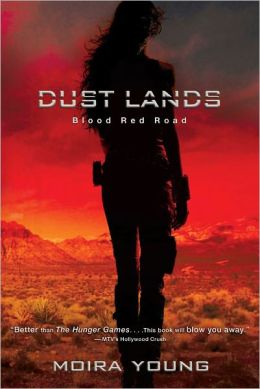
"Blood Red Road" by Moira Young (W1 &W2)

Well, It's Definitely Something

Blood Red Road

By Moira Young

The Dust Lands Series, Book 1


Blood Red Road (Dust Lands Series #1)

# Pgs: 480

_________________________________________________________________________________

Overview:


Saba has spent her whole life in Silverlake, a dried-up wasteland ravaged by constant sandstorms. The Wrecker civilization has long been destroyed, leaving only landfills for Saba and her family to scavenge from. That's fine by her, as long as her beloved twin brother Lugh is around. But when four cloaked horsemen capture Lugh, Saba's world is shattered, and she embarks on a quest to get him back.

Suddenly thrown into the lawless, ugly reality of the outside world, Saba discovers she is a fierce fighter, an unbeatable survivor, and a cunning opponent. Teamed up with a handsome daredevil named Jack and a gang of girl revolutionaries called the Free Hawks, Saba’s unrelenting search for Lugh stages a showdown that will change the course of her own civilization.

Blood Red Road has a searing pace, a poetic writing style, and an epic love story—making Moira Young is one of the most exciting new voices in teen fiction.

_________________________________________________________________________________

Review:


Do you like mindless violence?
A dystopian society novel?
A post-apocalypse fiction?
Or how about a really weird book?
You're gonna want to check this book out then, 'cause it's seriously interesting. Moira Young took a serious risk with writing this book in the way that she did, and for me, at least, it turned out quite well. From the first few written words, you're drawn in to the story just by the accent that Young writes in. Rather than perfect English and the odd accent just when a character speaks, Young carries the accent throughout the entirety of the novel. Now, I'm sure there are books out there just like this one in that aspect, but this is admittedly the first time I've ever read a book written like this. Young writes this book so that it's almost like it's bridging the fourth wall (or whatever it's called). In Young's book, Saba is talking to us. She's relaying to us the story. It's kind of difficult to describe just what I'm trying to say unless you've read the book. It's not so different that characters relay the story to us as the reader, but I mean Young specifically wrote the book as if the entirety of it is just one long (rather one-sided) conversation.
You have to read it to understand it, but regardless the different way that Young wrote the book is something that I can appreciate. It took some getting used to, but in the end I couldn't have imagined the book written in any other way.
In case you can't tell by the cover or the overview, this book is a dystopian society type of novel. These kinds of books have been in lately, I've noticed, though it's not like I have a problem with it. I love to read these kinds of books. In fact, this book is a perfect example of the type of book I like to read.
Dystopian, a bit of crazy (okay, a lot of crazy), a dash of romance, a plethora of adventure, faintly reminiscent of Spartans; there's nothing fluffy about this novel at all. It's all hard edges and rooting for the home team. Very interesting aspect to read from.
Saba, as a main character, is a riot to follow. You feel as much sympathy for her as you do annoyance regarding her choices and situation. For over half the novel, you're under the impression that Saba hates her little sister and is only keeping her alive for Lugh's sake. Yet, there were many chances that Saba had and many choices that Saba made that made it so obvious to me that she couldn't have done what she had done if she didn't love her sister (even the tiniest bit). I understand though, from the many other times that I've read stories in which one or both of the characters has a twin, that when you are a twin you almost become caught up in your own little bubble of twin-hood. I don't know if that has any support to it, and yet that's the only way I can think of to describe Saba's and Lugh's relationship as siblings. For years they'd been caught up in their own little world as brother and sister, and Emmi disrupts that just as much as Saba blames Emmi for their mother's miscarriage, if not more than, and so Saba holds it against her.
Of course, we can't continue on without discussing the casual flirtation between Saba and Jack. Jack is portrayed as this mysterious, handsome, tough and gentlemanly kind of guy. He catches Saba's eye when the two were, ahem, imprisoned, and from then on is able to keep it. It develops slowly, but it's cute to watch as Jack nonchalantly (and un-obviously) pursues her with the excuse about the "rule of three".
It's obnoxious to a point to read about Saba's infatuation with getting her brother back. It's like she's obsessed with this idea that things can return to the way that they used to be, or that things can become better than they used to be once Lugh is back safe and sound. As the reader, we know that, of course, in these kinds of situations nothing can return to the way that they used to be. They say that things get worse before they get better, which is quite obvious what the second book in this series is leading up to... the worse.
But that's for another time.
Regardless, this was a book that I thoroughly enjoyed reading. The plot ideas, the character construction (Saba's stubborn nature specifically), the development of the story from beginning to end, and the quite original way in which Young had written this novel kept me reading this thing from beginning to end tirelessly. If I had to rate this book, I'd give it a four out of five. The mindless violence, while enjoyable, was sometimes difficult to believe in that one character couldn't have done something like what occurred all on her lonesome.
I'd recommend this book to lovers of dystopian societies, mindless violence, adventure, a touch (really more like a brief brush than a touch) of romance, and just something that's different to read should read this book. This book was seriously a good book, and very different to read. I loved it.
Thanks for reading; sorry for babbling, leave a comment below if you're interested. Thanks again!

Wednesday, March 5, 2014

"Whatever Happened to Janie?" by Caroline B. Cooney (V2)

A Dash of Complications

Whatever Happened to Janie?

By Caroline B. Cooney

The Janie Johnson Series, Book 2


Whatever Happened to Janie?

# Pgs: 224

_________________________________________________________________________________

Overview:


As Janie Johnson glanced at the face of the ordinary little girl on the milk carton, she was overcome with shock. She recognized that little girl—it was she. How can it possibly be true? But it is.
With the mystery of her kidnapping now unraveled, Janie's story continues, and the nightmare is not over. No one can bring back or relive the 12 years gone by. The Spring family wants justice, but who is really to blame? The Johnsons know that they must abide by the court decisions made, but it's difficult to figure out what's best for everyone.

Janie Johnson or Jenny Spring? Who is she? Certainly there's enough love for everyone, but how can the two separate families live happily ever after?

The members of two families have their lives disrupted when a teenage girl who had been kidnapped twelve years earlier discovers that the people who raised her are not her biological parents. Sequel to "The Face on the Milk Carton."

_________________________________________________________________________________

Review:

I liked this book only a slight bit more than the first book. The resolution to the climax was a little bit of a shift for me to get in to, from where the first book left off to what was happening currently. It was kind of a tough love to read once I realized exactly what was happening to Janie and her family.

I felt terrible for a good portion of the book, my compassion for the main character eating me alive. Cooney's books definitely make you think. On the one hand, you have the family that you love with all your heart, the family that raised you; and on the other there's the family that continued to love you, miss you, want you back, the family that looked for you for all the years that you were gone, that needed you to feel normal. It was almost tough to read, the kind of emotions this book inspired.

Janie, in this book, becomes the most desperately confused child that I've read about recently. It got to a point where her vulnerablilty, her stubborn rebelliousness and rude behaviour, made me want to take this character under my wing. I mean, I can't 'cause I'm real and Janie's a fictional character, but I'm a sucker for looking out for people. I worry about everyone, though I don't let anyone else know that. Janie's troubles make me wish that I could just reach through the pages to reassure her. I wouldn't necessarily agree with the choices that she made involving her two families, or the way she acted on them, but I can understand why she would do that. Her one family might love her, might miss her, might be her biological family, but as far as she is concerned her other family, the family within which she was raised, that she loves; that's her real family.

The cover of the book is a mite bit misleading, especially since the call happened in the first book and it wasn't as all dark and dangerous as this one implies. Though maybe it's supposed to have a symbolic meaning, now that I think about it. That one phone call changed Janie's life, and now she's almost trapped in this moment of her life, she's trapped with being removed from the family she loves to the family that wants her home safe.

It's a story about emotional suffering. It's touching to read, heart breaking even. You can see how much her biological family loves her, and how much she doesn't want to go to live with them regardless of the fact that she was kidnapped. She feels terrible, because she doesn't want to have to choose one family over the other, except that she does and she feels like she has to. For her, she has no memories of her biological family except for some scattered moments here and there. For her, her adoptive/kidnapped parents are her real parents. It's terrible, because everyone's trying to do the right thing and everyone's suffering because of it. The parents that raised her, the Johnson's, are trying so hard to encourage their sort of daughter to get to know the parents she never had a chance to know. They never really had a choice in the matter of her leaving them though, and it's tearing her apart. They already lost one daughter. Yet the other family already lost one daughter. Both families lost a daughter, both families don't want to lose another daughter, Janie is left without much of a choice, and since both families are trying so hard to do the right thing.

If anything, Cooney's series is something to think about. A scenario that makes sense, but is none the less conflicting. Who? What? When? Where? Why?

As the second book is better than the first, I'm not going to put an age recommendation on this one. So I'd recommend this book to mystery, drama lovers. There's a lot of drama in this book series. I'd rate this book a three or four out of five. With the second book, I'm beginning to really like this series.

With that in mind, thanks for reading~